Why Are They Called Bases? The Acid Backbone and the Four Letters Hanging Off It
Bases hang from the spine of an acid. A name points at a capacity, not at a behavior. The backbone is silent. All the difference is in the side group.
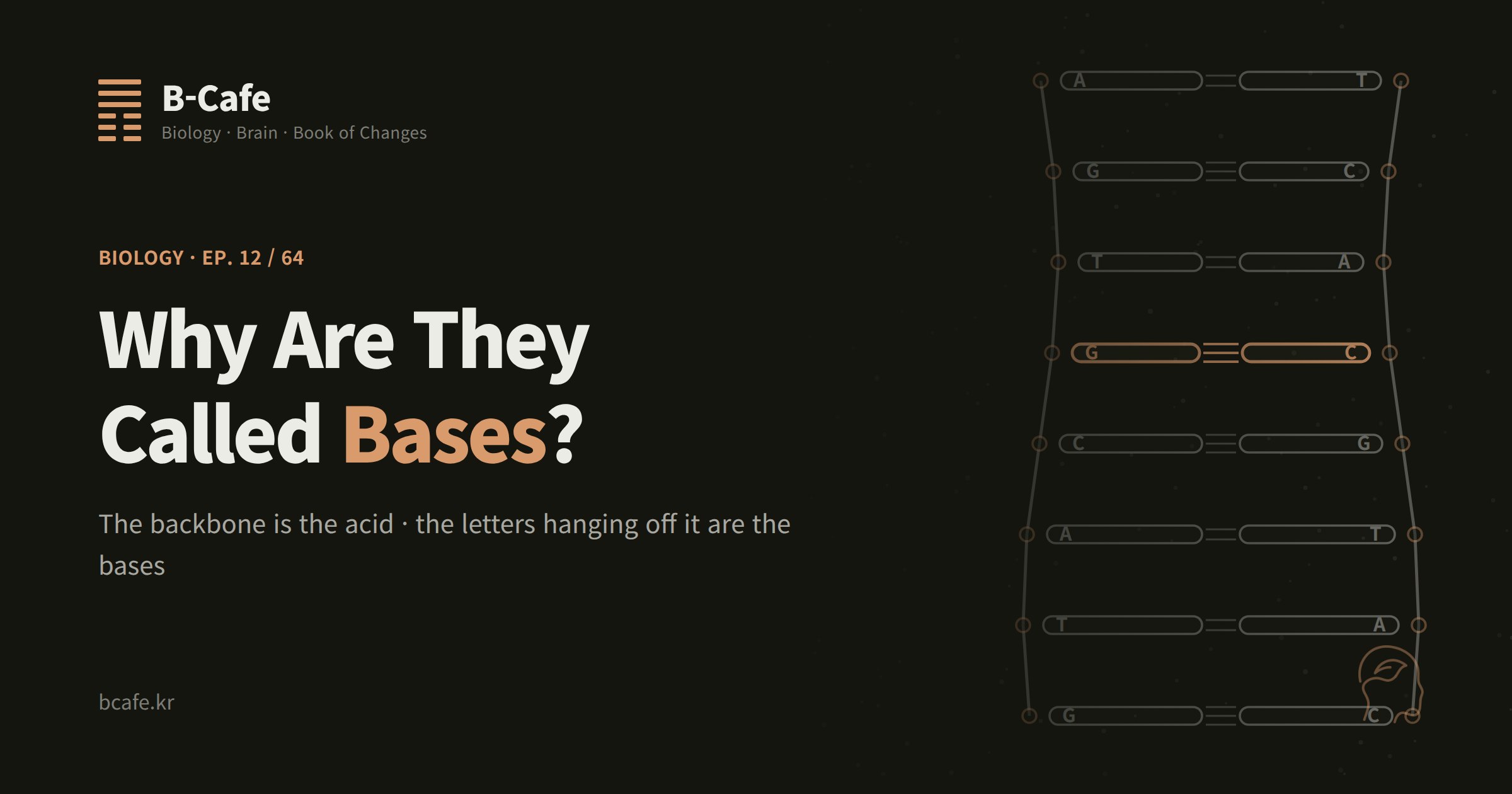
For a long time the word base in DNA looked like the name of a position on the sugar. A functional group, perhaps.
It is not. It is the opposite of an acid. Base.
The word had been learned. The concept had not.
Oxygen is a wrong name too
The previous piece said carbohydrate was a name applied in error. Here is a larger one.
Oxygen. From oxygène: the acid-former.
Lavoisier believed every acid contained this element and named it accordingly. He was wrong. Hydrochloric acid contains no oxygen at all.
The name stayed anyway. In French, in English, in the Chinese characters East Asia translated it into.
A name is the hypothesis of its moment, fossilised. Every term in use now is one of these.
The acid is in the spine
A nucleic acid is acidic. The word is in the name.
Where does the acidity come from?
The phosphate of the sugar-phosphate backbone.
The first dissociation constant of a phosphodiester is low. At physiological pH it has surrendered its proton entirely and carries negative charge. It is the same charge that makes the two strands push each other apart.
The spine is the acid.
The side groups are the bases
From each sugar on that spine hangs one small molecule.
Each carries nitrogen in its ring, and that nitrogen holds a lone pair not spent on bonding.
A lone pair can accept a proton. Under the Brønsted–Lowry definition that is a base.
| Part | Property |
|---|---|
| Sugar-phosphate backbone | acid — gives up a proton |
| Side group | base — can accept one |
An acid and a base dividing one molecule between them.
The word base itself was introduced by Rouelle in 1754, meaning the substrate that gave a salt its solid form when it met an acid. Not the definition in use today. Another fossil.
Except they do not accept one
One layer further down.
They are called bases, and inside a cell they almost never take a proton.
| Site | pKa |
|---|---|
| Adenine N1 | about 3.5 |
| Cytosine N3 | about 4.2 |
| Guanine N7 | about 2.4 |
A cell interior sits near pH 7.4, far above all of these. All four stay neutral.
The name points at a capacity, not at a behavior.
It says the structure could accept a proton. Not that it lives doing so.
A base is not a salt
Drug labels carry names like hydrochloride and sodium salt.
Those are salts. Not bases.
| English | What it is |
|---|---|
| acid | gives up a proton |
| base | accepts a proton |
| salt | the ionic compound left after the two neutralise |
In English the two words share nothing. In Korean and Japanese they are 鹽基 and 鹽 — one character apart.
Meiji-era Japan coined both while translating Western chemistry, and Korea inherited the pair. A confusion that does not exist in the original language was manufactured in translation and then set hard.
The moment a discipline is imprisoned by its vocabulary, it becomes an ordeal.
One of the five corners is not carbon
A correction to carry over from the previous piece.
The pentose is often described as a five-carbon ring. It is not.
| Ring position | What it is |
|---|---|
| C1′ C2′ C3′ C4′ | four carbons |
| O4′ | one oxygen |
The ring closes with four carbons and an oxygen. The fifth carbon, C5′, stands outside it holding the phosphate.
It is a pentose because the sugar has five carbons, not because the ring has five carbons.
The base attaches at C1′. One position on the ring.
The four names are laboratory addresses
There are only four side groups.
| Letter | Root | First pulled from |
|---|---|---|
| G guanine | guano | bird droppings |
| T thymine | thymus | calf thymus |
| C cytosine | κύτος | cell |
| A adenine | ἀδήν | gland |
Albrecht Kossel isolated and named most of them through the 1880s and 1890s. The Nobel Prize in Physiology or Medicine followed in 1910.
Not one of the names says anything about function. All four record where the substance was extracted.
A name is the laboratory’s address, not the molecule’s identity.
The sequence is not accidental
In 1950 Chargaff found a ratio that held across species. The amount of A equals the amount of T; the amount of G equals the amount of C.
Three years later the reason arrived.
A pairs with T by two hydrogen bonds. G pairs with C by three.
Weak bonds. Exact ones. Any single bond breaks easily; billions acting at once do not come undone.
Same backbone, different letters. Identity divides there.
Checking the numbers
A somatic cell holds 46 DNA molecules. Twenty-three from the father, twenty-three from the mother.
| One set | about 3.05 billion base pairs |
| Two sets | about 6.1 billion base pairs |
| Letters | about 12.2 billion |
The same figure as the pentose count in the previous piece, because every sugar carries exactly one base.
Change one of those 12.2 billion and a protein can change, a surface antigen can change, an immune response can change.
The number is enormous and the difference is one.
Sixty-four — same bits, different origins
Four letters group in threes. Four cubed: 64 codons.
Those 64 specify twenty amino acids. Precisely: 61 specify amino acids and 3 specify stop.
Decoding began in 1961, when Nirenberg and Matthaei built phenylalanine out of UUU.
Now the arithmetic.
| Bits per position | Positions | Total | |
|---|---|---|---|
| Codon | 4 bases = 2 bits | 3 | 26 = 64 |
| Hexagram | 2 lines = 1 bit | 6 | 26 = 64 |
Both are six bits.
There is no causality here. No historical link joins molecular biology to The Changes. Two different designs arrived at the same information capacity.
Why six bits in both cases is worth asking, though. Each had a few dozen things to distinguish. One more position wastes capacity; one fewer falls short. Sixty-four is what that interval yields.
The excess is the safeguard
Sixty-one codons for twenty amino acids leaves a threefold surplus on average.
It looks like waste. It is not.
The wobble hypothesis, proposed by Crick in 1966. The third position of a codon pairs loosely, so a change there often brings in the same amino acid regardless.
Which means a mutation at the third position frequently does nothing at all.
In 1998 Freeland and Hurst generated random alternative codes and compared them. The standard code sat roughly one in a million on a scale of how little the amino acid’s properties shift when a mutation lands.
The redundancy is not spare room. It is an error sink.
This article’s definition
Fixed here.
The information of life does not ride on the structure. It rides on the substitution.
The spine repeats and barely changes. The backbone is silent. All the difference comes from four letters hanging at its side.
Which is why 否 follows 泰. If everything got through, nothing would be a letter. If A reached anything at all, pairing would not be a concept. The pairing exists because the rest is blocked.
The intruder does not break the structure
Not the bodyguards. Not the backbone.
What it is after is the letter.
Not breaking the structure — altering the sequence. Change the sequence and the protein changes, the marker changes, the immune response changes.
This is not a metaphor. Lineages carrying reverse transcriptase and integrase insert their own sequence directly into the host genome. The traces are still there.
About 8 percent of the human genome is sequence derived from endogenous retroviruses.
One twelfth of what the eight bodyguards are guarding is already the intruder’s writing.
The form is left standing. The meaning is changed. That is enough.
In short
- The acidity of a nucleic acid comes from the backbone phosphate; the side groups are the bases. One molecule holds both
- They are called bases but take no protons at physiological pH — adenine N1 pKa about 3.5, cytosine N3 about 4.2
- Base and salt are different words. The 鹽基 / 鹽 confusion was manufactured in Meiji-era translation
- Oxygen is a wrong name too. Hydrochloric acid contains none
- One of the pentose ring’s five positions is oxygen (O4′). C5′ stands outside; the base attaches at C1′
- The four letters are named for guano, thymus, cell and gland — all extraction sites. Kossel took the 1910 Nobel
- A somatic cell holds 46 DNA molecules, about 6.1 billion base pairs, about 12.2 billion letters
- Of 64 codons, 61 specify amino acids and 3 stop. Codon and hexagram are both six bits, with no causal link
- The redundancy is an error sink, not waste. Wobble is the mechanism
- About 8 percent of the human genome derives from endogenous retroviruses
This piece is rebuilt for search readers from “Base” of the serial essay The Great Corona Swindle. The original’s point of view is kept; the mechanisms and numbers have been reset against primary sources.
Frequently asked
- If a nucleic acid is acidic, why are its components called bases?
- Because the acidity and the basicity live on different parts of the molecule. The acidity comes from the phosphate of the sugar-phosphate backbone, whose first dissociation constant is low enough that it carries full negative charge at physiological pH. The side groups attached to each sugar carry ring nitrogens with lone pairs — structures able to accept a proton, and therefore bases under the Brønsted–Lowry definition. An acid and a base divide the same molecule between them.
- Do the bases actually take protons?
- Almost never at physiological pH. Adenine N1 has a pKa near 3.5, cytosine N3 near 4.2, guanine N7 near 2.4. Cell interiors sit around pH 7.4, well above all of these, so the four stay neutral. The word base names a structural capacity, not what the molecule does inside a cell.
- How do a base and a salt differ?
- A base is the opposite side of an acid: it accepts protons. A salt is what remains after an acid and a base neutralise each other — an ionic compound. The hydrochloride and sodium salts named on drug labels are all salts, not bases. In Korean and Japanese the two words differ by a single character (鹽基 and 鹽), a confusion created in Meiji-era translation that does not exist in the English pair base and salt.
- Is there any connection between 64 codons and the 64 hexagrams of The Changes?
- There is no causal connection. The structures are comparable though. With four bases, one position carries two bits; three positions give six bits, 2 to the sixth, 64. With two kinds of line, one position carries one bit; six positions give six bits again, 64. Two different designs arriving at the same information capacity, not a shared origin. Of the 64 codons, 61 specify amino acids and 3 are stop signals.
References
- Jensen, W. B. (2006). The origin of the term "base". Journal of Chemical Education, 83(8), 1130. — How Rouelle introduced the word base in 1754.
- Chargaff, E. (1950). Chemical specificity of nucleic acids and mechanism of their enzymatic degradation. Experientia, 6(6), 201–209. — The equal amounts of A and T, of G and C.
- Watson, J. D. & Crick, F. H. C. (1953). Molecular structure of nucleic acids. Nature, 171, 737–738. — Base-pair hydrogen bonding and the double helix.
- Verdolino, V., Cammi, R., Munk, B. H., Schlegel, H. B. (2008). Calculation of pKa values of nucleobases and the guanine oxidation products. Journal of Physical Chemistry B, 112(51), 16860–16873. — Protonation and deprotonation pKa values for the nucleobases.
- Crick, F. H. C. (1966). Codon-anticodon pairing: the wobble hypothesis. Journal of Molecular Biology, 19(2), 548–555. — Loose pairing at the third position, and the degeneracy it produces.
- Nirenberg, M. W. & Matthaei, J. H. (1961). The dependence of cell-free protein synthesis in E. coli upon naturally occurring or synthetic polyribonucleotides. PNAS, 47(10), 1588–1602. — The first codon read: UUU specifies phenylalanine.
- Freeland, S. J. & Hurst, L. D. (1998). The genetic code is one in a million. Journal of Molecular Evolution, 47(3), 238–248. — The standard code is biased towards limiting the damage of mutation.
- Lander, E. S. et al. (2001). Initial sequencing and analysis of the human genome. Nature, 409, 860–921. — About 8% of the human genome derives from endogenous retroviruses.
- Dahm, R. (2008). Discovering DNA: Friedrich Miescher and the early years of nucleic acid research. Human Genetics, 122(6), 565–581. — The early isolation of the nucleobases, Kossel included.
- Nurk, S. et al. (2022). The complete sequence of a human genome. Science, 376(6588), 44–53. — The human haploid genome at about 3.05 billion base pairs.
Published October 2, 2026