What's Actually Inside a Cell? Scaled Up 5 Million Times
Blow one cell up 5 million times and you get a dome 50 metres across. It is almost entirely water, and everything else floats in it.
Blow a single cell up 5 million times and you get a dome 50 metres across — about 165 feet.
It is not empty. It is almost entirely water. The proteins, the power plants, the building that stores the blueprint — all of it is floating in that water, trembling.
Textbook diagrams cannot show this. In the diagram the cell sits still and the parts are pinned in place. In reality nothing is pinned to anything.
Why “cell”?
Cell. A small room. The word came from monks’ cells and prison cells before it came to biology.
A human body is made of roughly 36 trillion of these rooms. A 2013 study said about 37 trillion; a 2023 study said about 36 trillion. Both are estimates. The number moves with body size and sex, and it is not a constant. Any article that quotes it like a law of nature should be read carefully.
Why 5 million times?
A nanometre is not a size any human sense can hold. Write “5 nanometres” and no picture forms.
Five million is the conversion that puts it in your hands. At that magnification a cell becomes a stadium and a protein becomes a quail egg.
This series uses the same scale throughout.
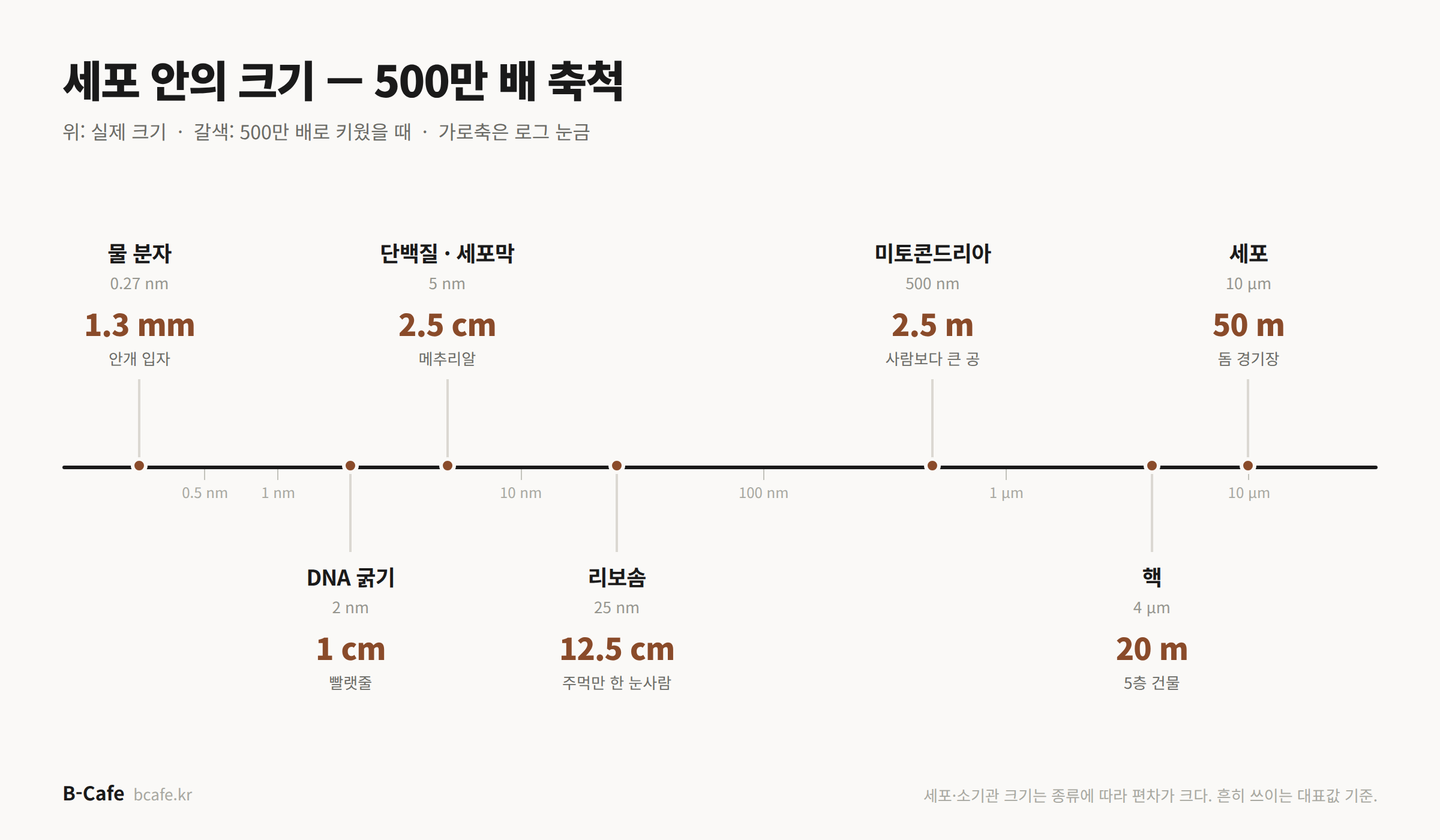
What everything becomes at that scale
| What | Real size | × 5,000,000 | Feels like |
|---|---|---|---|
| Cell | ~10 μm | 50 m (165 ft) | a domed stadium |
| Water molecule | ~0.27 nm | 1.3 mm | a speck of fog |
| Protein | ~5 nm | 2.5 cm | a quail egg |
| Ribosome | ~25 nm | 12.5 cm | a fist-sized snowman |
| Membrane thickness | ~5 nm | 2.5 cm | a wall a finger thick |
| DNA (width) | ~2 nm | 1 cm | a clothesline |
| Mitochondrion | ~0.5 μm | 2.5 m (8 ft) | a ball taller than you |
| Nucleus | ~4 μm | 20 m (65 ft) | a five-storey building |
| DNA (total length) | ~2 m | 10,000 km | a quarter of the way around Earth |
Cells and organelles vary enormously by type. These are commonly cited representative values.
The dome is mostly water
Water molecules 1.3 millimetres across fill the space like fog.
Everything floats on that fog.
Quail-egg proteins. Life runs on protein. Structure, reactions, signalling — protein does all of it.
Fist-sized snowmen. Ribosomes.
A large lump (the large subunit) with a smaller lump (the small subunit) sitting on it. The two drift apart most of the time. When they meet a strand to read — messenger RNA — they close around it and lock together. When the job is done they separate again.
These are the factories that stamp out the proteins. A snowman whose head and body only join when there is work.
And several balls 2.5 metres across, scattered through the space. Mitochondria. The power plants.
This is where most diagrams get it wrong. Mitochondria are usually drawn about the size of a ping-pong ball. At this scale they are taller than you are — twenty times a ribosome. Power plants are not small. And they are not necessarily separate: they fuse into branching networks.
The nucleus — a building to hold the blueprint
Inside the 50-metre dome sits another sphere, 20 metres across, submerged in the water.
The nucleus.
It exists to keep the blueprint from leaving. Inside is a thread far finer than a hair — 1 centimetre thick at this scale. DNA.
The thread is wound onto histone proteins, the way thread winds onto a spool. Winding cuts the volume, and only the stretch that needs reading gets pulled loose.
The rope is not tied down in one place. It runs along the walls, crosses the open space, curves loosely through the whole 20-metre interior — so that any page can be opened at once.
When 2 metres becomes 10,000 kilometres
String out all the DNA in a single human cell and you get about 2 metres.
Scale it up and that is 10,000 kilometres — roughly a quarter of the way around the Earth.
One lap of a 50-metre dome takes about 157 metres. Ten thousand kilometres would wrap it more than 60,000 times.
And those 2 metres fit inside a nucleus 4 micrometres wide. That is what histones are for.
The membrane — a guard who can be bought
The edge of the dome is a wall of fat 2.5 centimetres thick.
Match-shaped lipids line up with their heads toward the water and their tails toward each other. The water-liking end and the water-hating end sort themselves. Nobody assembled it.
The wall neither seals nor opens. It permits selectively.
It is a guard.
And it can generally be bought. There are channels, there are signals, and there are things that can imitate a signal. That is what a virus does for a living.
In short
- A cell is not a bag with parts pinned inside it. It is a dome full of water
- Everything in it floats and shakes
- The power plant is not small. At this scale it is taller than you
- The blueprint is 2 metres long and folds into 4 micrometres
- There is a guard, but the guard is not absolute
This piece is rebuilt for search readers from the closing chapter of the serial essay The Great Corona Swindle. The numbers have been recalculated at publication and differ from the original text in places. The next piece follows the intruder who gets into this dome.
Definitions
- The 5-million-times scale
- A fixed magnification this series uses to move cell interiors into human senses. At this scale a cell is a 50-metre dome and a water molecule is a 1.3-millimetre speck of fog. It exists to convert nanometre structures into sizes a hand can imagine.
Frequently asked
- How many cells are in the human body?
- Roughly 36 trillion. A 2013 study put it at about 37 trillion (3.72 × 10^13); a 2023 study revised it to about 36 trillion. Both are estimates and vary with body size and sex. Neither is a constant.
- What is a cell mostly made of?
- Water. Most of the cell interior is water, and every other structure is suspended in it. Textbook diagrams showing a bag of machine parts miss this completely.
- How does 2 metres of DNA fit inside a cell?
- It winds around histone proteins, the way thread winds around a spool. Wound up it becomes a much shorter, thicker fibre, and only the stretch being read gets unwound.
References
- Bianconi, E. et al. (2013). An estimation of the number of cells in the human body. Annals of Human Biology, 40(6), 463–471. — Gave about 3.72 × 10^13 cells.
- Hatton, I. A. et al. (2023). The human cell count and size distribution. PNAS. — Revised to about 36 trillion. The count is an estimate that shifts between studies.
- Milo, R. & Phillips, R. — Cell Biology by the Numbers / BioNumbers database — Source for the cell, organelle and molecule sizes. The conversions here are calculated from these ranges.
- Mitochondrial dimensions — Reported at roughly 0.5–1 μm across and 1–10 μm long. Highly variable by cell type and state; they also fuse into networks.
Published September 20, 2026 · Last updatedSeptember 21, 2026