Why the Empty Shell Stays — A Cicada's Exuvia, Form as Ceremony, and One Grain of Sand
The inside left long ago and the shape is still hooked to the bark. Bringing a large thing down has never taken a large force. It was already hollow.
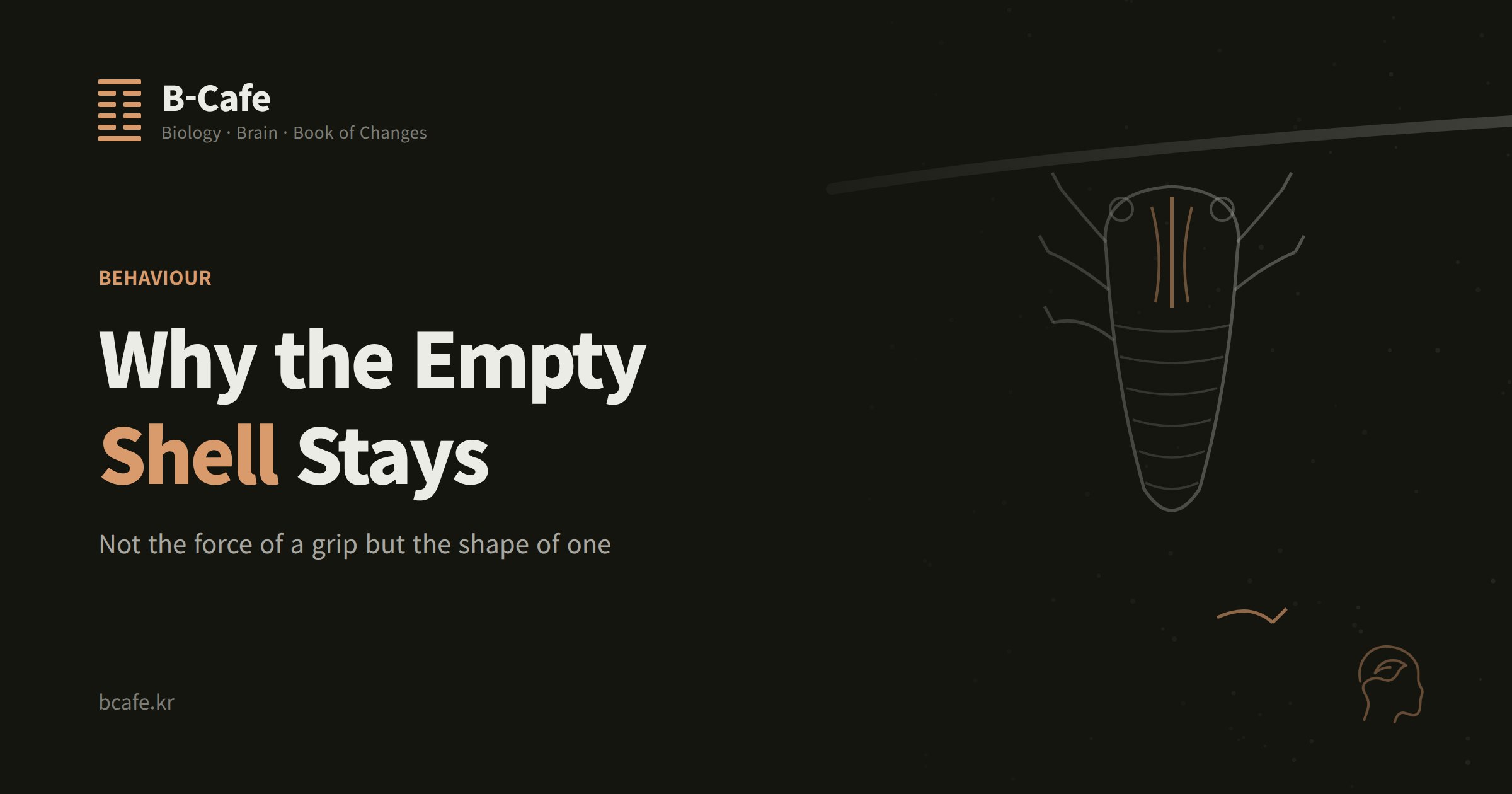
The wind moved and a cicada shell swung at the end of a dry branch.
The back was split open. The hooked legs were still gripping the bark.
From a distance it looked alive. Up close you could see straight through it.
No blood, no muscle. None of the noise that tore the summer nights open.
The inside had left long ago, and the shape was still attached to the tree.
Being hollow is not an accident
There is a mechanism behind how light the shell is. It is a designed outcome.
An insect’s exoskeleton is several layers of chitin and protein. The outer layers are sclerotised and hard; the inner ones are comparatively soft.
Moulting runs in this order.
| Step | What happens |
|---|---|
| ① | a new cuticle is built beneath the old one |
| ② | moulting fluid is secreted between the two |
| ③ | its enzymes digest the inner layers of the old cuticle |
| ④ | the released chitin and protein are reabsorbed into the new body |
| ⑤ | the back splits and the body climbs out |
Everything recoverable is taken. What remains is the hardened outer layer, which cannot be.
That is why the shell is light and translucent. Not that the contents left — the contents ate the inner wall on the way out.
Not a grip, but the shape of a grip
The legs are the stranger part.
They still appear to be gripping. They are not.
The cuticle at the claw tips is already sclerotised, so it stays set in exactly the shape that held the bark just before the moult. A hook of the right form with no muscle and no nerve behind it.
What remains is not the force of a grip but the shape of one.
So it does not fall. The place is held by form, not by function.
The time underground
The time that went into making that form was not short.
Cicadas in Korea generally spend several years below ground. The periodical cicadas of North America go further: thirteen or seventeen years underground, then a synchronised emergence.
A form built over years or over more than a decade sings for a few weeks above ground and is left as a shell.
What goes in and what remains are not proportional.
Content makes the name, then only the name is left
The order starts correct. Something is accomplished, and people put a name to it.
With time the order sometimes inverts. The content is gone, the name remains, and people read the name. What is left inside becomes a later question.
Sociology has a name for this.
In 1977 John Meyer and Brian Rowan wrote that organisations do not run on efficiency alone. They need forms the outside world accepts as legitimate in order to secure resources and standing.
So the form stays after the function has ended. The two called it myth and ceremony.
They added one more thing. The structure visible from outside becomes decoupled from how the work is actually done inside. The two can run separately and the organisation holds.
In 1983 DiMaggio and Powell added a layer. When organisations are uncertain about what actually works, they copy the form of whoever looks successful. Form replicates, not content.
An old sign makes even an empty building look grand.
Words point forward, footprints lead back
Start watching what someone brings rather than who they are and something else comes into view. The words always face the future while the footprints run the other way.
That gap has been measured too.
In 1934 Richard LaPiere travelled the United States with a Chinese couple and called at 251 hotels and restaurants. They were refused at one.
After the trip he sent a questionnaire to the same establishments. Would you accept Chinese guests?
Over 90 percent of those who replied said they would not.
Words and behavior ran opposite. The study has well-known design flaws, and the finding that attitudes and actions do not automatically align has held up across decades of work since.
People lie with their mouths; the trail they left is harder to fake.
Cruel about others’ illusions, generous about one’s own
Some people see that a thing is empty and still cannot leave. They believed it a long time, put time into it, and explained its value to other people.
Writing down now that the inside is gone puts every judgement made since up for reassessment. This is where the object being protected changes. The outer layer has to be treated as still functioning, or the time spent stops counting.
And the same person spots someone else’s illusion instantly.
In 2007 Pronin and Kugler accounted for the asymmetry. The introspection illusion.
| Judging | On what basis |
|---|---|
| Oneself | inner intention — I know what I meant |
| Others | behavior — only what is visible |
One’s own intentions are inspectable and other people’s are not. So there is always a reason ready for oneself, and for everyone else only the result remains.
This is the root of the bias blind spot from the other day.
How long it took to take down a seventeen-year sign
I have stood in that place myself.
I ran a pharmacy from 2002 to 2019. Seventeen years. It was the sign I saw every morning as I raised the shutter, and the name the neighbourhood called me by.
On the day it closed, taking the sign down took a few minutes.
Seventeen years came off with one ladder and a few tools. On the ground it was a plastic board.
Mounted, it had weight. Laid on the pavement it was a light panel. The dignity came down with it.
What the pharmacy shelf showed every day
The same thing shows up in products.
An old name has been sold under that name for decades. Over those years the manufacturer can change, the strength can be adjusted, the formulation can be altered.
The customer reads the name and picks it up. “That one, please.”
Point at the ingredient panel and explain, and most will not hear it. They have trusted that name for thirty years.
What changed is the content. What remained is the name. And the transaction closes on the name.
Taking it apart — one grain
The wind passed again. A fingertip met the back.
A dry sound, and one leg came away. That was the whole of it.
I had carried the premise for years that taking down something large would take a large force. The premise was wrong.
A 1987 paper by Per Bak, Chao Tang and Kurt Wiesenfeld inverted that intuition.
Drop sand one grain at a time onto a pile. At a certain slope it reaches criticality. What the next grain does is then undetermined: nothing, a small slip, or the collapse of the whole pile.
The size of the avalanche was set not by the last grain but by the state the pile had already reached.
They called it self-organized criticality: the system arrives at that state by itself, without anyone tuning it there.
If the inside is already gone, what is needed at the end is not force. It is one small confirmation.
This article’s definition
Fixed here.
The moment of collapse is not the moment of the touch. It is the whole span during which only the form remained.
The hexagram here is 頤. Look at the figure: yang at the very bottom and the very top, four yin between. Hard on the outside and hollow within. It is read as an open jaw, hence 頤.
Its Image reads 君子以愼言語 節飮食 — the noble one is sparing with words and measured in what he takes in.
Being sparing with words joins to what came before. The jaw is where words leave and where everything enters. What went in and what went out is what stays inside it.
Monologue of one among 1031
A shell is worth nothing to us.
When one host finishes we find another body. Names and positions won while alive are letters cut into an outer layer.
One species alone treats a mark briefly fixed to a body as a permanent one. It attaches a name to it, grades it, and reserves in advance what it will be called once gone. Then stands shocked at the fact of the hollow inside.
It is not a shock. What is hollow comes down when it comes down.
Under the tree there is a broken shell.
What collapsed did not collapse just now.
In short
- At moulting the inner layers of the old cuticle are digested and reabsorbed; only the hardened outer layer is left
- The shell appears to grip because the claws set in that shape, not because force remains
- Periodical cicadas spend 13 or 17 years underground and a few weeks singing before being left as a shell
- Meyer and Rowan: organisations hold forms for legitimacy, not efficiency — myth and ceremony
- DiMaggio and Powell: under uncertainty, organisations copy form rather than content
- LaPiere 1934: refused at one of 251 establishments, yet over 90% said in writing that they would refuse
- Introspection illusion: oneself judged by intention, others by behavior
- Self-organized criticality: the avalanche size is set by the pile’s state, not the final grain
- 頤 is hard outside and hollow within, and its Image counsels sparing speech
This piece belongs to the “Behavior” chapter of the serial essay The Great Corona Swindle. The experience of running a pharmacy and closing it is the author’s own; the biological and sociological concepts have been reset against primary sources. No specific company or individual is indicated.
Frequently asked
- Why is a cicada shell hollow?
- The moulting process is built that way. A new cuticle is laid down beneath the old one, and moulting fluid secreted between them carries enzymes that digest the inner layers of the old cuticle. The released chitin and protein are reabsorbed and used to build the new body. What remains is only the hardened outer layer, which cannot be recovered. That is why the shell is light and translucent.
- Then why does it not fall?
- It is not holding on. The cuticle at the tips of the claws is already sclerotised, so it stays set in exactly the shape that gripped the bark just before the moult. A hook of the right form, with no muscle and no nerve behind it. What remains is not the force of a grip but the shape of one.
- Has the maintenance of obsolete forms been explained?
- Meyer and Rowan set it out in 1977. Organisations do not run on efficiency alone; they need forms the outside world recognises as legitimate in order to secure resources and standing. So a form persists after its function has ended, as myth and ceremony. The same account explains the decoupling of the visible structure from how the work is actually done inside.
- Does bringing down something large require a large force?
- Not at criticality. In 1987 Bak, Tang and Wiesenfeld showed that a pile built one grain at a time reaches a slope at which the next grain may cause nothing, a small slip, or a collapse of the whole pile. What determined the size was not the last grain but the state the pile had already reached.
References
- Merzendorfer, H. & Zimoch, L. (2003). Chitin metabolism in insects: structure, function and regulation of chitin synthases and chitinases. Journal of Experimental Biology, 206(24), 4393–4412. — Digestion and reabsorption of the old cuticle's chitin at moulting.
- Zhu, K. Y., Merzendorfer, H., Zhang, W., Zhang, J., Muthukrishnan, S. (2016). Biosynthesis, turnover, and functions of chitin in insects. Annual Review of Entomology, 61, 177–196. — The layered structure of insect cuticle, sclerotisation, and material recovery.
- Williams, K. S. & Simon, C. (1995). The ecology, behavior, and evolution of periodical cicadas. Annual Review of Entomology, 40, 269–295. — Thirteen and seventeen years underground, and synchronised emergence.
- Meyer, J. W. & Rowan, B. (1977). Institutionalized organizations: formal structure as myth and ceremony. American Journal of Sociology, 83(2), 340–363. — Organisations maintaining form for legitimacy rather than efficiency.
- DiMaggio, P. J. & Powell, W. W. (1983). The iron cage revisited: institutional isomorphism and collective rationality in organizational fields. American Sociological Review, 48(2), 147–160. — Organisations copying one another's forms under uncertainty.
- LaPiere, R. T. (1934). Attitudes vs. actions. Social Forces, 13(2), 230–237. — The classic field study in which stated attitude and actual behavior diverged sharply.
- Pronin, E. & Kugler, M. B. (2007). Valuing thoughts, ignoring behavior: The introspection illusion as a source of the bias blind spot. Journal of Experimental Social Psychology, 43(4), 565–578. — Judging oneself by intention and others by behavior.
- Bak, P., Tang, C., Wiesenfeld, K. (1987). Self-organized criticality: An explanation of 1/f noise. Physical Review Letters, 59(4), 381–384. — In a system at criticality, a small input can produce a large event.
Published October 5, 2026