The Prison of the First Person — The Bias Blind Spot, Solomon's Paradox, and What a Seat in the Audience Costs
The eyes point outward only. So the world gets blamed for a lifetime. Raising the vantage point is not contemplation. It is fixing your coordinates.
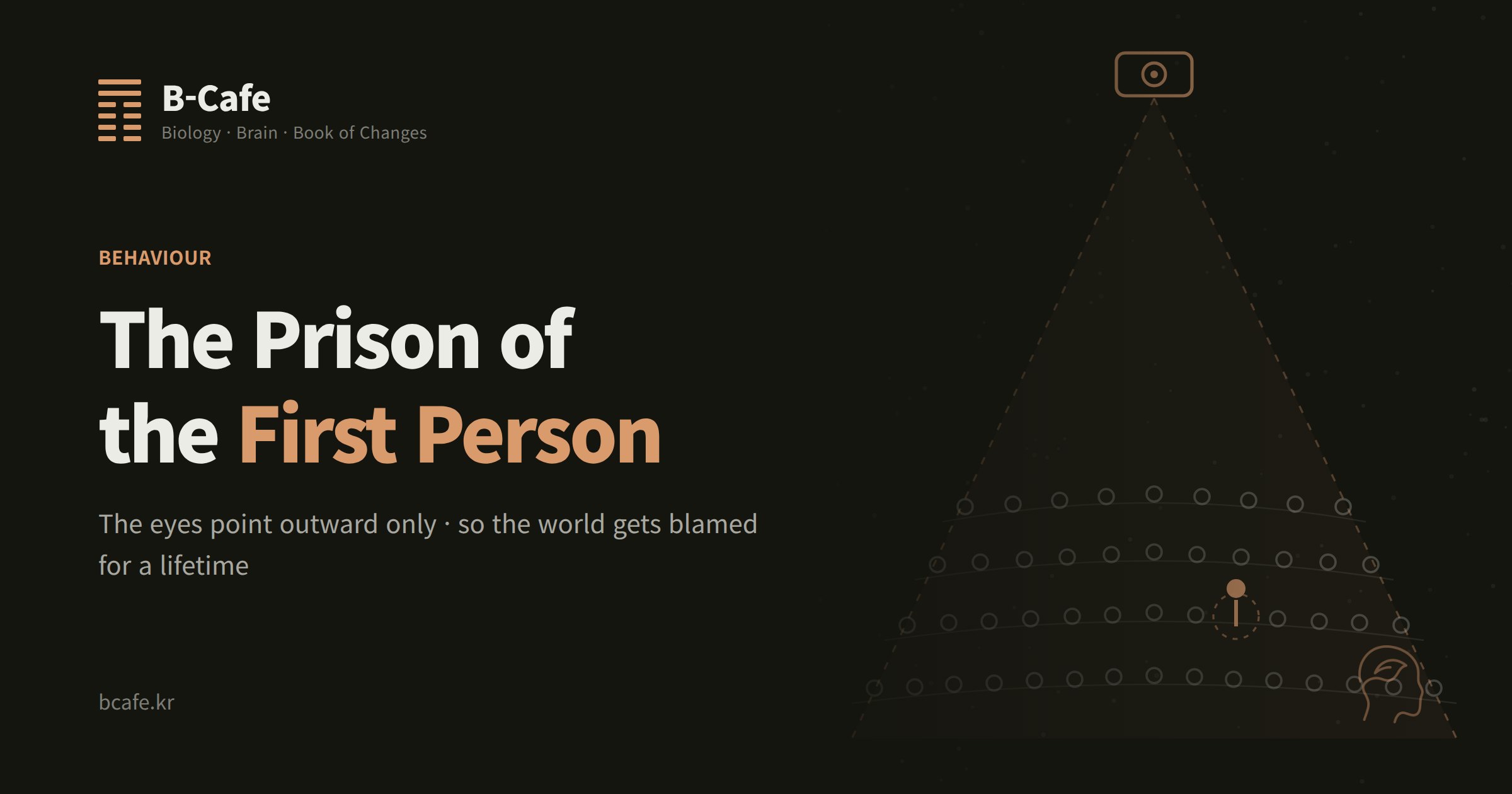
Hang a camera at the top of the sky and look down at yourself.
What is there?
One biological machine, going round in search of three meals’ worth of calories a day in order to prepare tomorrow morning’s waste.
Decades of that. At some point hormones took the body over and it thrashed. Now the blood has cooled and the stretch is quieter.
So what happens now.
The eyes point outward only
Start with the anatomy.
The human eyeball is set facing outward. Nobody has seen their own face directly. A whole life of mirrors and photographs, all of it indirect.
Yesterday’s piece said there is a real hole in the visual field and the brain fills it. There is a larger one.
The entire observation rig is bolted to a single point.
The first person is not an adopted stance. It is the default wiring.
So the outside gets blamed for a lifetime. They were wrong, the circumstances were strange, the luck ran out.
Success is mine, failure is circumstance
The longest-surviving attribution effect is the self-serving bias, set out by Miller and Ross in 1975. Success goes to one’s own ability, failure to external conditions.
A textbook correction is needed here.
The actor-observer asymmetry printed everywhere since the 1970s — I explain my behavior by situation and yours by character — came out with an overall effect near zero in Malle’s 2006 meta-analysis.
One stretch did not vanish. Where the outcome was bad.
| Effect | |
|---|---|
| Ordinary behavior explanation | close to none |
| Negative outcomes | persists |
When things go well, the two viewpoints barely differ. The split opens at failure.
Knowing the bias does not let you apply it
In 2002 Pronin, Lin and Ross described a set of cognitive biases to participants and then asked: compared with the average person, how far do these apply to you?
Most answered that they were less biased than average.
They knew the biases existed. They had just read the definitions. They answered that way anyway.
This is the bias blind spot. Structurally identical to the retinal one. Not an absence of signal — an absence of instrument, at that one location.
The finding the same group reported a year earlier is more direct. The illusion of asymmetric insight: people believe they understand the other party better than the other party understands them. Both parties believe it.
Solomon’s paradox
Balanced judgement about someone else’s problem; nothing of the kind about a structurally identical problem of one’s own.
Grossmann and Kross named it in 2014. Solomon’s paradox, after the king who judged others and could not settle his own household.
The part that matters comes next.
In the same work, participants were made to describe their own situation in the third person. Not what should I do, but what should he do.
The gap between reasoning about self and reasoning about others closed.
What Kross’s group reported separately in 2014 points the same way. Under stress, people who worked through the situation addressing themselves by name or in the third person differed in both emotional regulation and performance.
Distance is not produced by insight. It is produced by grammar.
The camera in the sky is not a metaphor. It is an executable operation.
What the watching seat costs
Darley and Latané, 1968. When someone needed help, the more people a participant believed were present, the lower the probability of intervening and the longer it took.
Diffusion of responsibility.
Each person calculates that somebody else will handle it. The calculation holds for everyone simultaneously. So nobody does.
The two seats differ like this.
| Watching | Doing | |
|---|---|---|
| What it involves | appraising, commenting, predicting | noticing, taking it on, acting |
| What it costs | nothing | time, risk of failing, exposure to judgement |
| Change produced in the situation | 0 | possible |
An action that costs zero arrives at the situation as zero.
Five gates
In 1970 Latané and Darley broke the move from watching to acting into five steps. Block one and nothing after it happens.
| Step | What blocks it |
|---|---|
| ① Notice the event | attention is elsewhere |
| ② Interpret it as needing intervention | pluralistic ignorance |
| ③ Assume personal responsibility | diffusion of responsibility |
| ④ Know what to do | the procedure is unknown |
| ⑤ Actually do it | fear of being judged |
The pluralistic ignorance at ② is the nastiest. You look around and everyone is sitting still, so you conclude it is not serious. Everyone looks at everyone and reaches the same conclusion. Nothing happens, not because nobody knows, but because each reads the others’ silence as evidence.
The audience inhibition at ⑤ has the same shape. The embarrassment of stepping forward and being wrong. That cost gets priced above the cost of sitting still.
Most people stop at ② and ③. Not for want of will — it finished at the interpretation stage.
A plan is a sentence, not a resolution
How to get through ④ and ⑤ is comparatively well established.
Implementation intention, set out by Gollwitzer in 1999. Not a resolution to try, but fixing when, where and how in advance, as one sentence.
I will work hard at it ✕ If situation X arises, I will do Y ○
Gollwitzer and Sheeran’s 2006 meta-analysis pooled 94 studies and reported an effect of medium size or better. Groups that had only set a goal and groups that had written the condition-action sentence behaved differently.
The mechanism is plain. It makes it unnecessary to decide in the moment. The moment requiring a decision is the moment bias is running, and the trick is not to trust yourself there.
Metacognition is not contemplation
Flavell’s 1979 definition has two parts.
| Knowledge | what I know and what I do not |
| Regulation | measuring whether the current strategy works, and changing it |
The second is the load-bearing one.
Sitting still like an enlightened monk and surveying the world is not metacognition. That is a stop.
Metacognition runs all the way through to locating exactly what you are holding, after you have looked down at the whole board. Measure, then change.
This article’s definition
Fixed here.
Metacognition is not the gaze turned down on oneself. It is the procedure of changing the next move because of what the gaze returned.
Yesterday’s piece defined The Changes as a science of action. The same structure applies. Reading the sign is observation. It becomes action only once the movement changes.
The condition Rocky entered on was not the odds. It was to be standing when the last bell went — one condition, and meeting it meant taking the hits.
Nothing moves from a seat that costs nothing to occupy. Noise from the stands is not scored by the referee.
Monologue of one among 1031
Size is not something I envy.
However vast the host, there is one way in: a particular protein on the surface. Without it, proximity counts for nothing.
Receptor tropism. ACE2 for a coronavirus; CD4 and a co-receptor for HIV. The inside opens only at the door the key fits.
So I do not measure size. I look for the contact point.
The one crying out that it is unfair is the host. Crying does not bind to a receptor.
Raise the camera again.
Three names fit the thing standing down there. The one it was done to. The one watching. The one out of the seat.
Which of the three is not settled by how it feels. It is settled by whether anything got done today.
The watching side does not intervene. It keeps the record.
In short
- Human eyes point outward only. The first person is default wiring, not a stance
- Self-serving bias credits success to ability and failure to circumstance
- The textbook actor-observer asymmetry mostly vanished in the 2006 meta-analysis, surviving only for negative outcomes
- Bias blind spot: people rate themselves less biased than average right after reading the definitions
- Illusion of asymmetric insight: both sides believe they understand the other better
- Solomon’s paradox: wise about others’ problems, not about one’s own
- Describing one’s own situation in the third person closed that gap. Distance comes from grammar
- Intervention falls as onlookers rise, because responsibility divides by headcount
- Intervention passes five steps. Most people stop at pluralistic ignorance and diffusion of responsibility
- An implementation intention fixes condition and action in one sentence, skipping the in-the-moment decision
- Flavell’s metacognition has two parts, knowledge and regulation, and regulation is the load-bearing one
This piece belongs to the “Behavior” chapter of the serial essay The Great Corona Swindle. The original’s point of view is kept; the psychological concepts have been reset against primary literature.
Frequently asked
- Is metacognition a contemplative stance?
- No. The concept Flavell set out in 1979 covers knowledge of one's own cognitive processes together with the monitoring and regulation of them. Not a state of emptying out emotion and surveying the world, but the work of measuring what you know, what you do not, and whether the current strategy is working — and then changing it. Contemplation is a stop. Metacognition is an operation.
- What is the bias blind spot?
- In the 2002 study by Pronin, Lin and Ross, participants read descriptions of several cognitive biases and then rated themselves as less susceptible than the average person. Knowing a bias exists does not let you apply it to yourself. The related illusion of asymmetric insight is more direct still: people believe they know the other party better than the other party knows them, and both sides believe it.
- What is Solomon's paradox and how is it crossed?
- It is the pattern of reasoning in a balanced way about someone else's conflict while failing to do so in a structurally identical conflict of one's own. Grossmann and Kross named it in 2014. In the same work, having participants describe their own situation in the third person rather than the first eliminated the gap between self and other. The distance is produced by grammar, not by insight.
- Why do people fail to act even when they know?
- Latané and Darley broke the move from watching to acting into five steps: noticing the event, interpreting it as something needing intervention, assuming personal responsibility, knowing what to do, and doing it. Block any one step and nothing after it happens. Pluralistic ignorance operates at the second, diffusion of responsibility at the third, and fear of being judged at the fifth.
References
- Flavell, J. H. (1979). Metacognition and cognitive monitoring: A new area of cognitive-developmental inquiry. American Psychologist, 34(10), 906–911. — The origin of the concept, defined to include monitoring and regulation.
- Pronin, E., Lin, D. Y., Ross, L. (2002). The bias blind spot: Perceptions of bias in self versus others. Personality and Social Psychology Bulletin, 28(3), 369–381. — Rating one's own bias below that of others.
- Pronin, E., Kruger, J., Savitsky, K., Ross, L. (2001). You don't know me, but I know you: The illusion of asymmetric insight. Journal of Personality and Social Psychology, 81(4), 639–656. — Believing you know the other better than they know you.
- Grossmann, I. & Kross, E. (2014). Exploring Solomon's paradox: Self-distancing eliminates the self-other asymmetry in wise reasoning. Psychological Science, 25(8), 1571–1580. — Self-distancing removed the self-other gap in reasoning.
- Kross, E. et al. (2014). Self-talk as a regulatory mechanism: How you do it matters. Journal of Personality and Social Psychology, 106(2), 304–324. — Referring to oneself in the third person changes regulation and performance.
- Darley, J. M. & Latané, B. (1968). Bystander intervention in emergencies: Diffusion of responsibility. Journal of Personality and Social Psychology, 8(4), 377–383. — Intervention falls as the number of observers rises.
- Latané, B. & Darley, J. M. (1970). The Unresponsive Bystander: Why Doesn't He Help? New York: Appleton-Century-Crofts. — The five-step decision model, with pluralistic ignorance and audience inhibition.
- Miller, D. T. & Ross, M. (1975). Self-serving biases in the attribution of causality: Fact or fiction? Psychological Bulletin, 82(2), 213–225. — Crediting success to the self and failure to circumstance.
- Malle, B. F. (2006). The actor-observer asymmetry in attribution: A (surprising) meta-analysis. Psychological Bulletin, 132(6), 895–919. — The textbook actor-observer asymmetry largely disappears under meta-analysis, surviving only for negative outcomes.
- Gollwitzer, P. M. (1999). Implementation intentions: Strong effects of simple plans. American Psychologist, 54(7), 493–503. — Fixing when, where and how in advance as a single sentence.
- Gollwitzer, P. M. & Sheeran, P. (2006). Implementation intentions and goal achievement: A meta-analysis of effects and processes. Advances in Experimental Social Psychology, 38, 69–119. — A meta-analysis across 94 studies, with an effect of medium size or better.
Published October 2, 2026