The Road That Is Not There — Imagination Is Drawing More Paths Into the Fog
The judgement of 小畜 is 密雲不雨. The clouds have gathered and no rain falls. It is the position of what has accumulated and not yet broken. A good plan is not one right answer but a map of several branches. The number of those branches turns fear into opportunity.
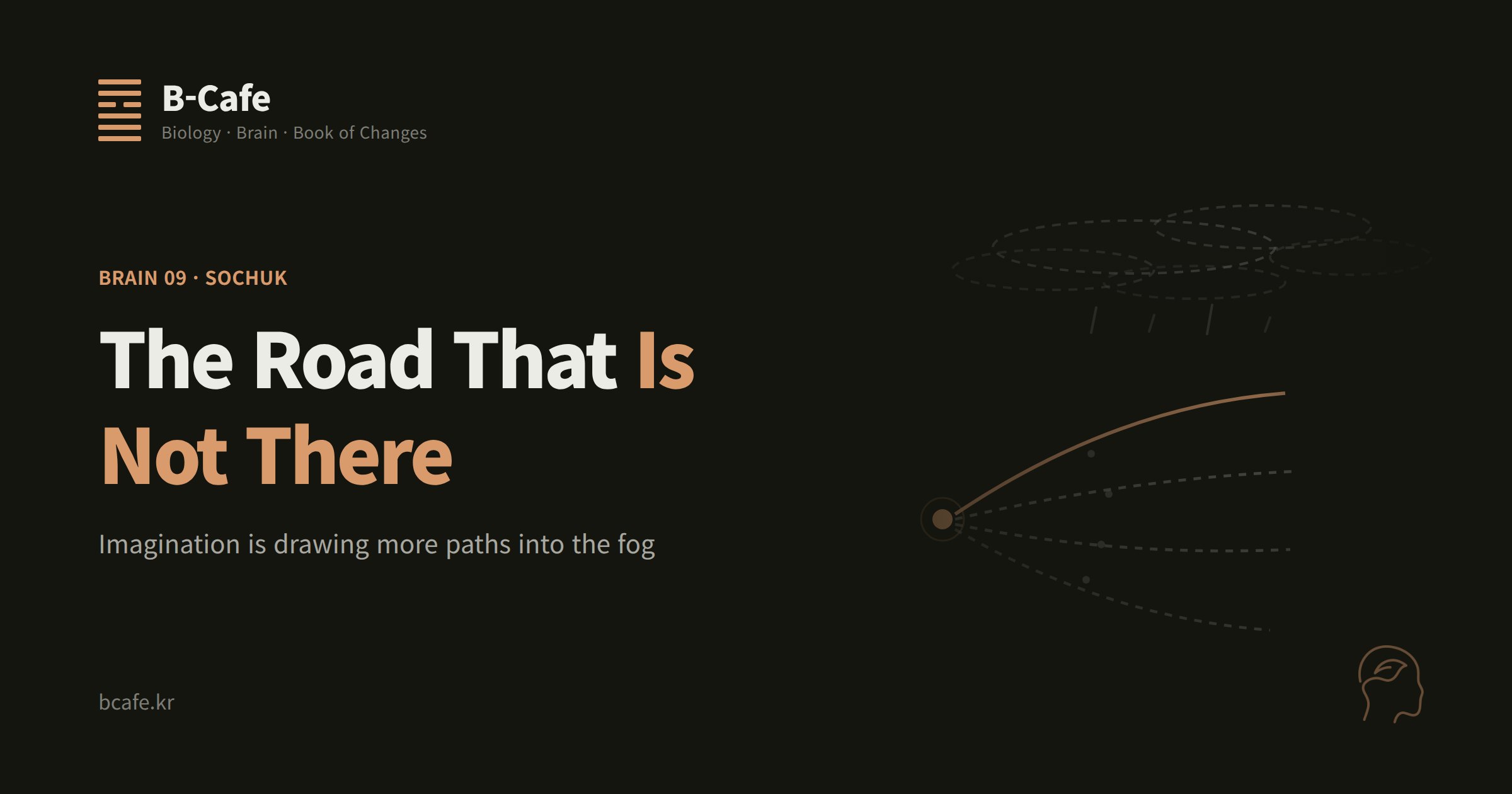
Imagination is the power to see a future that does not exist.
The moment what could not be seen is first drawn inside the mind, the future has already begun to open the other way.
In the world we live in the story is the starting point of every imagining.
Animals have stories too. They respond to the stimulus in front of them, they avoid danger, they move towards food.
But that is as far as it goes.
Their story stays at an order of actions for survival right now.
The human takes one step further.
On top of that story we lay “why” and “what if.”
Why did that happen. What becomes of it if it runs down another road.
“Why” takes hold of a cause already past, “what if” opens a road that has not yet come.
The moment those two questions meet, reality splits from a single conclusion into countless possibilities.
Imagination begins right there at the fork.
The previous piece set down that the story comes first and imagination stands on top of it. Today, what happens on top of that.
A good plan is not one map
A plan of action is a story.
But a good plan is not one right answer or a formula under glass.
A good plan is a map of several branches drawn and redrawn in the head to reach a single summit.
The road closes and you go round, the weather turns and you change ridge, the ground gives under your foot and you look for the next stone.
The more routes there are, the more uncertainty turns from fear into opportunity.
That sentence has been measured.
In 2006 Gollwitzer and Sheeran published a meta-analysis. They pooled 94 independent tests comparing people who were only made to set a goal with people made to tie situation and action together in advance in the form “if situation X arises, I will do Y.”
| Form | Result | |
|---|---|---|
| Goal intention | “I will exercise” | Baseline |
| Implementation intention | “When I get home and open the door, I put my training clothes on” | d = .65 |
What matters is that this is not a way of building willpower.
Link situation and action in advance and when the situation arrives no decision is needed at all.
Which means the reason a person does not stop in the fog is not courage but the number of branches drawn beforehand.
The person without imagination stops in front of the fog.
The person who has it draws a new road inside that fog.
Walking backwards from after the failure
Beethoven, who had lost his hearing, built it first in his head, let it sound again in his chest, and then put it down on the staff.
Beethoven’s hearing was set out in the previous piece. One study holds that he was not completely deaf at the 1824 premiere. The point is not whether the sound was zero but that the path for verifying what he had written against real sound was cut.
The same for the operator in the field. In the middle of the line of fire he makes the next way round.
Genius does not come from knowing many formulas.
It comes from the training of a private intelligence that draws a situation that is not there yet and walks even the failing road in advance.
An experiment attaches to that last sentence too.
In 1989 Mitchell, Russo and Pennington had people write the reasons for an event that had not happened yet. One side was asked in the future tense; the other was asked with the event recast as something already past.
| Tense of the question | Number of reasons produced |
|---|---|
| “What could go wrong” | Baseline |
| “What went wrong” | About 30% more |
It is called prospective hindsight.
Gary Klein turned it into a procedure. Before the work starts you nail it down — “this has failed completely” — and have the reasons written out. The premortem.
Only the tense of the question changed, and the number of visible roads changed with it.
Which means imagination may not be a problem of talent but a problem of the form of the question.
Draw the whole thing first. But in the field, do not hesitate.
That is the way to design the one life there is as a single work.
The person with only one road
But most people do not see the road that cannot be seen.
Or rather, they will not look.
Because the moment they stand in front of it, fear comes up before imagination does.
Ordinary people do not get past that fear.
Because they have one plan, or none at all.
| Routes held | When the road closes |
|---|---|
| One | They rage. Because that road was the only one |
| None | They cannot move. Because the fog is everything |
| Several | They change branch. Because the blockage becomes information |
Economics has a name attached to the middle row.
In 1961 Ellsberg showed that people dislike ambiguity, where the probability is unknown, more than risk, where it is known. This holds even when the size of the loss is the same.
Stopping in front of the fog is not a miscalculation. It is the avoidance of a state in which calculation does not hold.
So imagination is not simply the ability to draw a fine future.
It is the power to draw another road again in the very moment fear comes up.
But what if the body moves first
The one who sees the road that cannot be seen gets the future first.
But if, in front of that road, the body shakes first, the chest shrinks first, the fingertips stiffen first —
then the problem is no longer the territory of imagination alone.
That sentence meets the place neuroscience reached late.
In 2014 Joseph LeDoux, who had spent a life on the amygdala and fear, wrote a paper. Its title is “Coming to terms with fear.” Inside it is this sentence.
We should not have called it a fear system.
What he asked to be separated is this.
| Operation | Consciousness | |
|---|---|---|
| Defensive survival circuit | Threat detected → the body stiffens | Runs without it |
| Conscious fear | Feeling afraid | A different circuit |
LeDoux proposed replacing even the term “fear conditioning” with threat conditioning. There are patients with amygdala damage who feel fear, and amygdala activity is not in itself a marker of the emotion of fear.
The body stiffening first and feeling afraid are not the same event.
Which is why there are moments when the advice to “just draw another road” does not reach.
However many branches you add, the circuit turns first.
From there the human stands in front of the next question.
Why do I grow afraid first in front of a future that has not even happened.
Out of that depth comes the emotion the human finally cannot avoid.
The hexagram of this piece
小畜. Heaven (乾) below, wind (巽) above.
Of the six lines only one is yin. The fourth position. One small thing briefly holds five large ones.
The judgement hands over the picture of this piece exactly.
小畜 亨 密雲不雨 自我西郊
Success. Dense clouds have gathered and the rain does not fall. From our western outskirts.
The clouds have already piled up. And it is not yet rain.
That is where imagination accumulates. The road is not there yet; only what has gathered is.
The Sequence of the Hexagrams places 小畜 after 比.
比必有所畜 故受之以小畜
Draw close and there is necessarily something that accumulates. So Sochuk receives it.
| Episode | Hexagram | The position |
|---|---|---|
| 7 | 師 | A multitude gathers out of sight |
| 8 | 比 | Risen onto the earth, attaching |
| 9 | 小畜 | Accumulated, and not yet rain |
The definition this piece fixes
Fixed here.
Imagination is not a talent for seeing a road that is not there. It is the work of increasing the number of routes.
With one route a blockage becomes rage; with none the fog becomes everything. With several the blockage becomes information.
That work has a form. Tying situation and action together in advance (d = .65), and putting the failure down as something already past and walking backwards from it (about 30% more reasons generated).
Though there is a place where adding branches does not reach. The place where the body stiffens first. That is a different circuit.
Monologue of 1031 intruders
You draw roads.
We do not draw roads. There is nothing to draw. We only move into the empty box among the branches you drew.
The one with a single branch is easy. Block that one and he stops.
The one with several is hard. Each time we block, he changes branch.
But the one we stayed in longest was not the one with many branches. It was the one who only accumulated and never let it break.
A body where the clouds are dense and the rain does not fall.
That was the warmest place.
In brief
- The story comes first and imagination stands on top of it. ‘Why’ opens a cause already past, ‘what if’ a road not yet come
- A good plan is not one right answer but a map of several branches. As the routes multiply, uncertainty becomes opportunity
- Implementation intention — planning in advance in the form “if X, then Y”. d = .65 in a meta-analysis of 94 tests (Gollwitzer & Sheeran 2006)
- The real content of the effect is not willpower but the removal of the decision. When the situation arrives there is nothing to decide
- Prospective hindsight — put the future down as something already past and the reasons produced rise by about 30% (Mitchell et al. 1989)
- Klein turned this into a procedure called the premortem. Before the start you nail down “this has failed” and write the reasons
- The stop in front of the fog has a name. Ambiguity aversion — the side whose probability is unknown is systematically avoided (Ellsberg 1961)
- In 2014 LeDoux wrote “We should not have called it a fear system”. The defensive survival circuit and conscious fear are different circuits
- Which is why there is a place where adding branches does not reach. The place where the body stiffens first
- The judgement of 小畜 is 密雲不雨, dense clouds and no rain. Accumulated, and not yet broken
This is the ninth piece in the “Brain” chapter of the serial essay The Great Corona Swindle. The psychology and neuroscience experiments and the classical text have been reset against primary sources. No individual health advice or diagnosis is offered.
The next piece is “The Path of Feeling.”
Frequently asked
- Which comes first, imagination or the story?
- The story comes first. The story is a plan of action, and animals have it too. Responding to the stimulus in front of them, avoiding danger, moving towards food — that order is the story. Imagination appears when 'why' and 'what if' are laid on top of it. 'Why' takes hold of a cause already past; 'what if' opens a road that has not yet come. Where those two questions meet, reality splits from a single conclusion into several possibilities.
- Does planning in several branches actually work?
- It has been measured. In their 2006 meta-analysis Gollwitzer and Sheeran reported the effect of implementation intentions — deciding in advance in the form 'if situation X arises, I will do Y' — on goal attainment at an effect size of d = .65. It pools 94 independent tests. What matters is that this is not a way of building willpower. Link situation and action in advance and, when the situation arrives, no decision is needed at all. Which means the reason a person does not stop in the fog is not courage but the branches drawn beforehand.
- Why does walking a failing road in advance work?
- In 1989 Mitchell, Russo and Pennington showed that having people recast a future event as something that had already happened raised the number of reasons they generated by about 30%. It is called prospective hindsight. Gary Klein turned it into a procedure called the premortem. Before a project starts, you assume 'this has failed completely' and have people write down why. Ask 'what could go wrong' and few answers come; ask 'what went wrong' and many do. Only the tense of the question changed, and the result is different.
- Is fear a problem of imagination?
- It is a different circuit. In a 2014 paper LeDoux wrote that calling the amygdala circuit a 'fear system' had been a mistake. He named the non-conscious circuit that detects threat and triggers defensive responses the defensive survival circuit, and proposed separating it from consciously felt fear. He also proposed replacing the term fear conditioning with threat conditioning. The body stiffening first and feeling afraid are not the same event. Which is why there are moments when the advice to 'just draw another road' does not reach. From there on it is no longer the territory of imagination.
- What kind of hexagram is 小畜?
- The hexagram in which something small briefly holds something large. The image reads 風行天上 小畜 君子以懿文德 — wind moves above heaven; the noble one makes his writing and character fine. The judgement hands over a picture: 小畜 亨 密雲不雨 自我西郊, success, but dense clouds have gathered and no rain falls. It is the state of what has accumulated and not yet broken. The Sequence of the Hexagrams places 小畜 after 比, writing 比必有所畜 故受之以小畜 — draw close and there is necessarily something that accumulates, so Sochuk receives it.
References
- Gollwitzer, P. M. & Sheeran, P. (2006). Implementation Intentions and Goal Achievement: A Meta-analysis of Effects and Processes. Advances in Experimental Social Psychology, 38, 69–119. — The effect of planning in advance in the form 'if X, then Y' on goal attainment. 94 independent tests, d = .65.
- Mitchell, D. J., Russo, J. E. & Pennington, N. (1989). Back to the future: Temporal perspective in the explanation of events. Journal of Behavioral Decision Making, 2(1), 25–38. — Have a future event described as something already past and the reasons generated rise by about 30%. Prospective hindsight.
- Klein, G. (2007). Performing a Project Premortem. Harvard Business Review, 85(9), 18–19. — The article that turned prospective hindsight into a working procedure called the premortem.
- LeDoux, J. E. (2014). Coming to terms with fear. Proceedings of the National Academy of Sciences, 111(8), 2871–2878. — "We should not have called it a fear system." Separates the defensive survival circuit from conscious fear and proposes replacing fear conditioning with threat conditioning.
- Ellsberg, D. (1961). Risk, Ambiguity, and the Savage Axioms. Quarterly Journal of Economics, 75(4), 643–669. — Ambiguity aversion — systematically avoiding the side whose probability is unknown. The formal description of the choice to stop in front of the fog.
- Book of Changes, hexagram 9 (小畜): judgement and image. — 小畜 亨 密雲不雨 自我西郊 / 風行天上 小畜 君子以懿文德. The position of what has accumulated and not yet broken. The Sequence of the Hexagrams places 小畜 after 比.
Published October 17, 2026