The One Who Drew the Line — A Node Is Strong Only Against Pressure
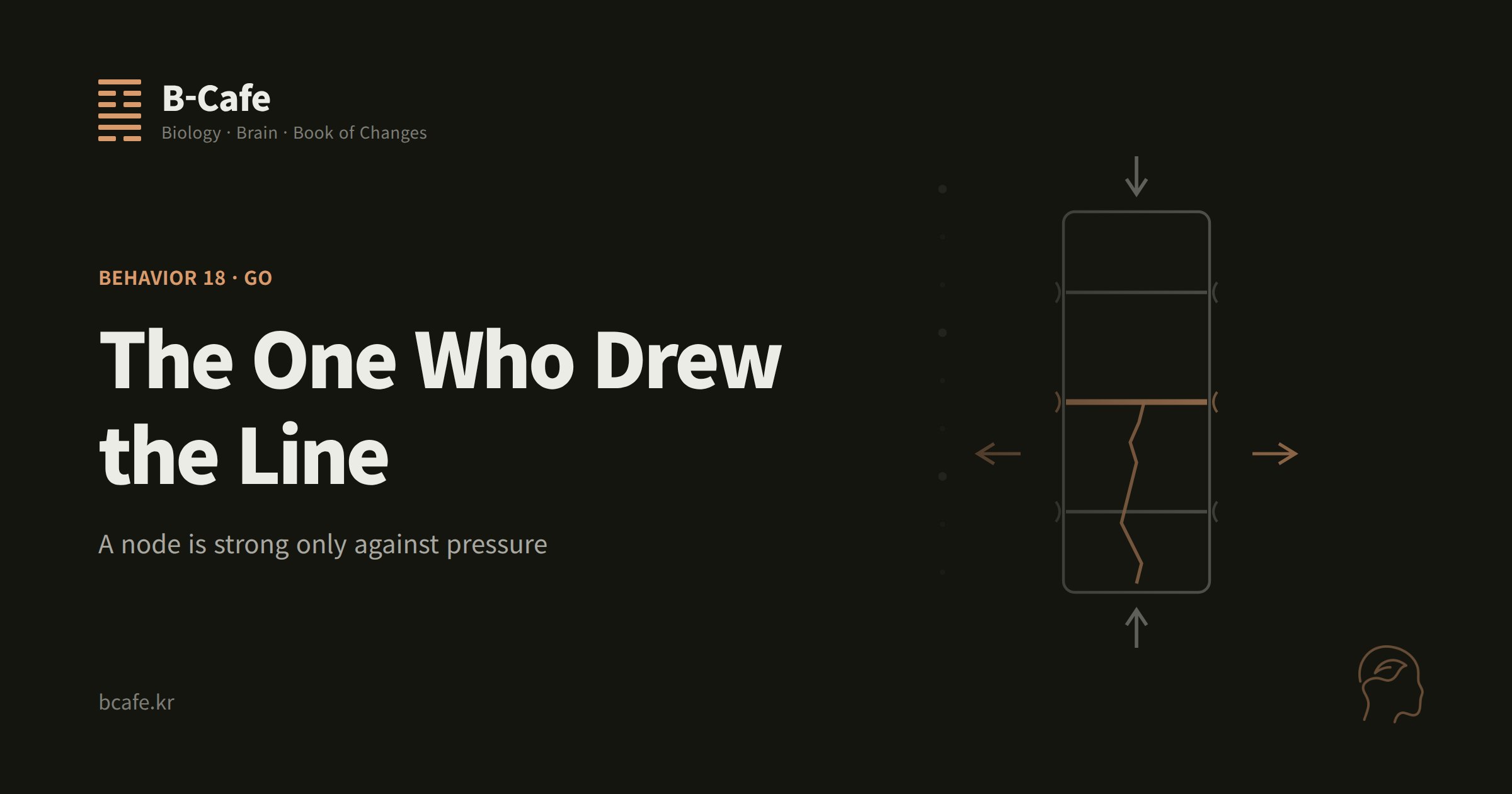
Bamboo stands because of its nodes — that is half true. Nodes help against compression and fail under tension. A line you draw yourself behaves the same way. Not a cure-all. And without a line there is no inside or outside.
I ran a pharmacy for seventeen years.
A large part of that work was saying no.
Someone wants a prescription-only medicine without the prescription. Someone wants the dose raised on their own say-so. Someone says another pharmacy gave it to them. You stand in the same spot several times a day.
Say no and that customer usually does not come back. In revenue terms it is a loss.
But soften the line once and you soften it further for the next person. Soften it twice and the line is gone. A pharmacy without that line is not a pharmacy. It is a shop with medicine stacked in it.
A boundary is a boundary only while it is held.
Correcting the bamboo
Bamboo nodes get summoned whenever boundaries come up. The nodes are what let bamboo stand, people say.
Half true.
Under compression and under tension the node does the opposite thing.
| Direction of load | What the node does | Evidence |
|---|---|---|
| Axial compression (buckling) | Helps. Thicker node walls raise the buckling load | Trinh et al. 2021 |
| Tension | Weak point. Node material has significantly lower tensile strength | Taylor et al. 2015 |
In 2015 Taylor and colleagues ran bending tests. The culm broke at the moment tensile stress reached exactly the tensile strength of the node. The failure mode was longitudinal splitting, and the crack was traced to the node.
Trinh’s 2021 buckling analysis shows the other face. Thickening the node wall raises both global and local buckling loads. Though if the diaphragm itself is too thin, the diaphragm is what buckles.
So:
The node is for not collapsing. It is not for not tearing.
Does the correction weaken the figure? The opposite.
A line you draw yourself works the same way. Strong against one kind of force, weak against another. Draw it and you will not collapse — and you may split right there. The way a customer peeled off each time I said no.
Drawing it knowing that is not the same as drawing it without knowing.
Scatter first, then bind
Yesterday the work was letting go. Releasing what was held, scattering the bindings.
渙. Wind passing over water. What was set comes loose.
But what is loosened and left loosened has no form. A river is a river because of its banks. Without banks it is a flood, not a flow.
The arrangement of the Book of Changes recorded this first.
The Sequence of the Hexagrams puts 節 after 渙 and says:
渙者離也 物不可以終離 故受之以節
Huan is dispersion. Things cannot remain dispersed forever. And so Jie receives it.
Fifty-nine is scattering and sixty is the node. The arrangement itself fixes the order.
Scattering and binding are not opposites. They are the front and back of one process. Bind without releasing and you get a tighter cage; release without binding and the thing disappears without a trace.
苦節不可貞
節 is usually read as a recommendation of restraint. The judgement does not read that way alone.
節 亨 苦節不可貞
Restraint brings success. Bitter restraint cannot be held to the end.
The hexagram that tells you to set a boundary states, in the same line, that a boundary which torments you will not last.
The image is more specific.
澤上有水 節 君子以制數度 議德行
Water above the lake is restraint. The noble one establishes measures and weighs conduct.
制數度 — to set the units of measure. To draw the graduations.
That is where it divides.
| Character | Result | |
|---|---|---|
| A yoke placed on you | Graduations from outside | 苦節. Holding it shaves you down |
| A boundary you set | Graduations from inside | Holding it sharpens your outline |
The same line. Whether it becomes a pen or the shape of a body depends on who drew it.
Enduring without end is not strength. It is holding someone else’s graduations and mistaking them for your own.
A virus does not breathe
The narrator of this series is a virus. One thing about that body should be exact.
A virus has no metabolism of its own. It generates no energy, does not respire, synthesises no protein by itself. Outside a host cell it sits chemically at rest.
No organs either. Genetic information and a shell to wrap it. That is all.
And still the code persists. It changes hosts and is read again in another cell.
The oceans alone are estimated to hold on the order of 1030 virus particles. For the planet the exponent goes up by one.
The side without a body lasted longer.
One caution. Having no body is not the same as having no boundary. A virus has a capsid — the shell around the genome. Without it the nucleic acid is degraded.
Information without a boundary is not preserved.
The hexagram of this piece
蠱. Wind (巽) below, mountain (艮) above.
The image reads 山下有風 蠱 君子以振民育德 — wind beneath the mountain; the noble one rouses the people and grows character.
蠱 is the figure of a vessel in which worms have bred. The hexagram for repairing what has been left too long.
The Sequence of the Hexagrams explains why it follows 隨.
以喜隨人者必有事 故受之以蠱 蠱者事也
One who follows others gladly will surely have work to do. And so Gu receives it. Gu is work.
The Behavior chapter walked exactly this order.
| Episode | Hexagram | The position |
|---|---|---|
| 16 | 豫 | Having prepared in advance |
| 17 | 隨 | Following, and letting go |
| 18 | 蠱 | Repairing what the following produced |
Follow only, and work accumulates. Scatter only, and form disappears. Repair is what comes next.
The definition this piece fixes
Fixed here.
A boundary is not the opposite of freedom. It is the condition under which freedom takes a shape.
And a boundary is not a cure-all. It holds against pressure and splits under pull. People peel off right there.
Drawing it anyway, knowing that — that is a boundary of your own.
And the same hexagram records it in advance: a bitter boundary cannot be held.
Monologue of 1031 intruders
You call the unbounded freedom.
We see it otherwise.
We have no organs. We do not breathe. And yet we have a shell. Without that shell we are degraded within minutes.
When the boundary goes, inside and outside go with it. With no inside and outside there is no ground for calling it one body.
What lasts is not what spreads without end. It is what can cut where cutting is due and cross to the next.
Many of the lines you stand behind are not lines you drew. You copied them down. Being shaved away while keeping copied graduations — you call that diligence.
Bitter restraint does not last. Your own classic wrote it first.
Do not live inside a line someone else drew.
And do not drift with no line at all.
You pass a node to get the next node. And past that node, the code is read again in the next body.
In brief
- Bamboo nodes help against compressive buckling and are weak in tension — opposite behavior by direction (Taylor et al. 2015; Trinh et al. 2021)
- Bending failure occurs when tensile stress reaches the node’s tensile strength, and proceeds as longitudinal splitting
- The Sequence of the Hexagrams places 節 (60) after 渙 (59). The node comes after the scattering
- The judgement of 節 reads 苦節不可貞 — bitter restraint cannot be held to the end
- 制數度 in the image of 節 is the setting of measures. Who drew them decides between a pen and an outline
- A virus has no metabolism, yet it has a capsid. A genome without a boundary is degraded
- 蠱 is the hexagram of repair; the Sequence places it after 隨 because following produces work
This is the eighteenth piece in the “Behavior” chapter of the serial essay The Great Corona Swindle. The pharmacy anecdote is the author’s own experience; the mechanics and the classical text have been reset against primary sources. No company or individual is referred to.
Frequently asked
- Is bamboo strong because of its nodes?
- It depends on the direction of the load. Against axial compression the nodes help: in the 2021 buckling analysis by Trinh and colleagues, thicker node walls raised both global and local buckling loads. Under tension the node is a weak point. In 2015 Taylor and colleagues found that node material has significantly lower tensile strength, and that in bending tests failure occurred at the moment tensile stress reached the tensile strength of the node. The failure mode was longitudinal splitting.
- Does 節 in the Book of Changes simply recommend restraint?
- Only half. The judgement reads 節 亨 苦節不可貞 — restraint brings success, but bitter restraint cannot be held to the end. The image reads 澤上有水 節 君子以制數度 議德行: water above the lake is restraint; the noble one establishes measures and weighs conduct. To establish measures is to draw the graduations. The same hexagram records in advance that a line which torments you will not hold.
- Is it accidental that 節 follows 渙?
- No. The Sequence of the Hexagrams reads 渙者離也 物不可以終離 故受之以節 — Huan is dispersion; things cannot remain dispersed forever, and so Jie receives it. The arrangement itself puts the node after the scattering. Scattering and binding are not opposites but consecutive phases of one process.
- Is a virus alive?
- It depends on the definition. A virus has no metabolism of its own: it generates no energy, does not respire, and synthesises no protein by itself. Outside a host cell it is a chemically inert particle. Yet it carries genetic information, replicates, and is subject to selection. It is usually treated as sitting on the boundary of life. The oceans alone are estimated to hold on the order of 10^30 virus particles.
References
- Taylor, D., Kinane, B., Sweeney, C., Sweetnam, D., O'Reilly, P., Duan, K. (2015). The biomechanics of bamboo: investigating the role of the nodes. Wood Science and Technology, 49(2), 345–357. — Node material has significantly lower tensile strength; failure initiates at the node.
- Trinh, L. C., Ansari, Q. M., Nguyen, P. T. T., Nguyen, T. K., Weaver, P. M. (2021). Effect of Wall Thickness and Node Diaphragms on the Buckling Behavior of Bamboo Culm. Advances in Intelligent Systems and Computing, 1284, 637–647. — Thicker node walls raise global and local buckling loads; thin diaphragms buckle themselves.
- Book of Changes, hexagram 60 (節): judgement and image. — 節 亨 苦節不可貞 / 澤上有水 節 君子以制數度 議德行.
- Book of Changes, Sequence of the Hexagrams (序卦傳), lower section. — 渙者離也 物不可以終離 故受之以節.
- Suttle, C. A. (2005). Viruses in the sea. Nature, 437(7057), 356–361. — Order-of-magnitude estimate of marine virus particles.
- Suttle, C. A. (2007). Marine viruses — major players in the global ecosystem. Nature Reviews Microbiology, 5(10), 801–812. — Absence of viral metabolism and dependence on the host for replication.
Published October 11, 2026