Everything Is Made by Mind — Consciousness Signs Off After the Fact
Not that wanting it hard enough brings it. The brain lifts up only what was prepared in advance. Consciousness arrives afterwards and puts its signature on it.
Whatever the mind of man can conceive and believe, it can achieve. — Napoleon Hill
Opening a self-help book feels like a sugar-coated dummy pill dissolving slowly under the tongue.
Want it badly enough and the universe conspires. Wealth and success come to you like iron to a magnet. Sentences like these circulate as doctrine.
The dummy pill does work. What it works on is fixed
Push the comparison all the way and it turns out to be accurate.
Placebo works. In 2010 Kaptchuk and colleagues gave patients with irritable bowel syndrome a pill while telling them plainly, “this contains no active ingredient”. Symptom scores still fell.
The limit is in the range. In 2001 Hróbjartsson and Gøtzsche collected the trials that compared a placebo group directly against a no-treatment group.
| What is measured | Placebo effect |
|---|---|
| Subjective symptoms such as pain | Small, present |
| Objective measures such as blood pressure or lab values | Not demonstrated |
Seventeen years behind a pharmacy counter is seventeen years of watching that boundary. It reaches the symptom, not the disease.
Self-help sits in the same place. Mood lifts while reading, and that lift is real. What it changes is the symptom, not the conditions.
The will shuts down first, exactly when it is needed
Why “pull yourself together” collapses in a crisis has a mechanism.
Intention, planning and impulse control are the work of the prefrontal cortex. That region is also the one most vulnerable to stress.
As Amy Arnsten set out in 2009, acute stress floods the area with norepinephrine and dopamine, and connectivity in the prefrontal cortex weakens rapidly. Control passes to older circuits — the amygdala, the striatum.
At the moment willpower is most needed, the region that supplies will goes down first.
What survives a crisis, then, is not the resolve formed in it. It is what was put into the body beforehand.
Wonhyo’s skull water — check the record first
So is “everything is made by mind” an anaesthetic for the weak?
Before arguing it, the sources have to be straightened out. What circulates in Korea and what is written down are not the same.
① The earliest record has no skull water
The episode involving Wonhyo (617–686) first appears in the Song Biographies of Eminent Monks (宋高僧傳), book 4, “Life of Uisang”, compiled by Zanning of the Northern Song in 988 — three centuries after Wonhyo’s death.
What it says: Wonhyo and Uisang slept in what they took for a cave, and at daybreak saw it was a tomb. Circumstances kept them a second night, and that night they were tormented by ghosts in a dream.
Drinking water standing in a skull and vomiting the next day is a later addition.
② 一切唯心造 is not recorded as his phrase
What the Song Biographies transmit is this.
「心生則種種法生 心滅則龕墳不二」
When the mind arises, all manner of things arise; when the mind ceases, cave and tomb are not two.
The four characters 一切唯心造 come from a verse in the Flower Garland Sutra, “Verses Sung in the Yama Palace”.
「若人欲了知 三世一切佛 應觀法界性 一切唯心造」
The two agree in sense. The sources differ, and the pairing is later. That distinction is kept here.
And 「心滅則龕墳不二」 shows the direction. This is not a claim that wanting things makes them so. It says the same physical space is a cave or a tomb depending on the conditions. The arrow points the other way.
Consciousness does not give the order
Here the neuroscience takes over.
We believe an “I” produces thought and issues instructions. The measurements reverse the order.
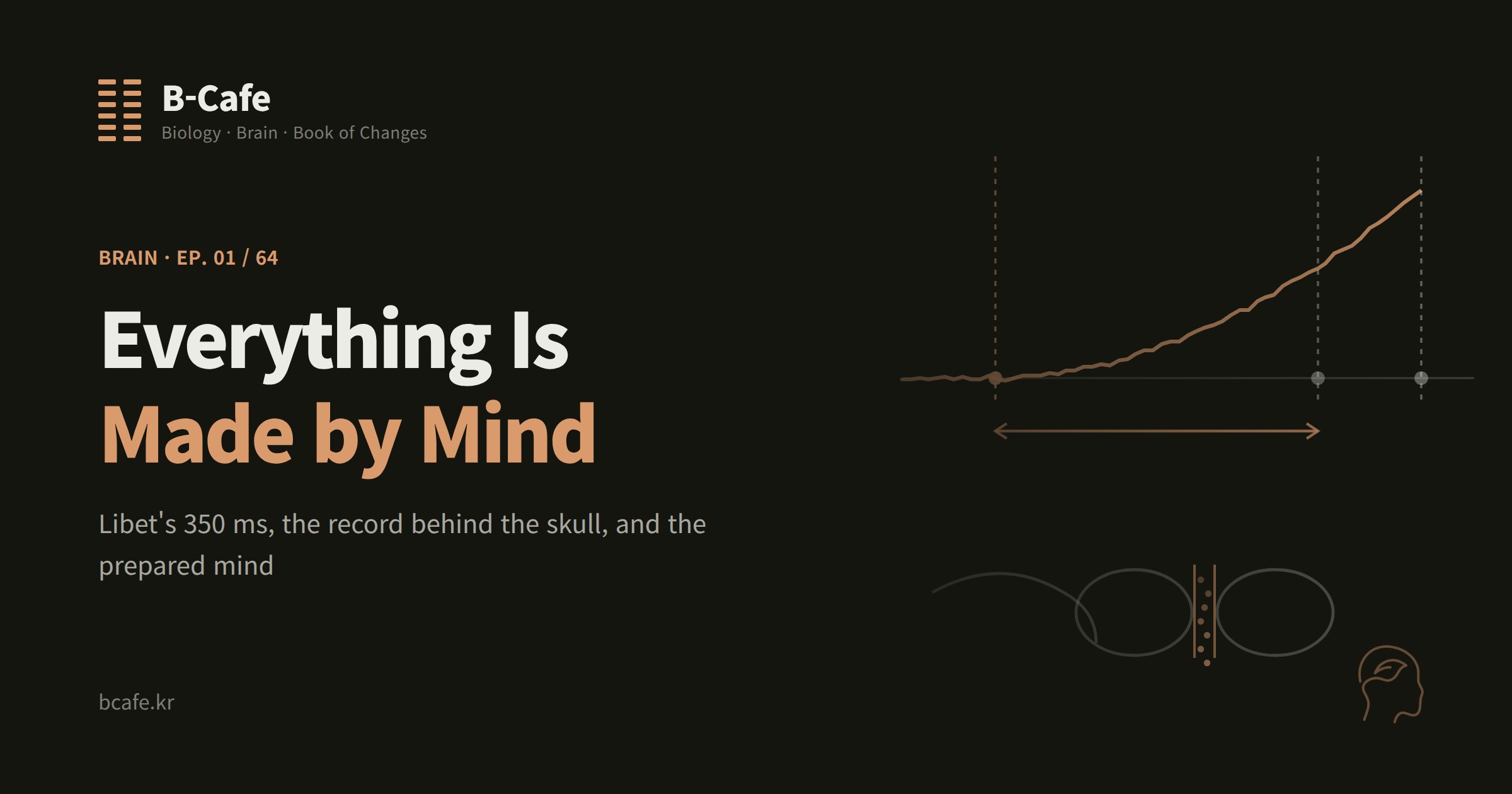
Benjamin Libet’s 1983 experiment is the best known.
| What was measured | When |
|---|---|
| Readiness potential begins to rise | about 550 ms before movement |
| Reported conscious intention | about 200 ms before |
| The finger actually moves | 0 |
The brain left about 350 ms earlier. Consciousness arrives after.
And here a correction is required
For thirty years this has been cited as evidence that free will does not exist. Used that way it is wrong.
In 2012 Aaron Schurger and colleagues put a finger on it. Cortical potentials drift up and down continuously, even at rest. A movement comes when that drift happens to cross a threshold.
The problem is the analysis. Averaging many trials backwards from the moment of movement selects, every time, only the rising stretch just before the threshold. That average looks like a smooth preparatory ramp.
The readiness potential may not be a decision signal but the trace of noise reaching a threshold.
Soon and colleagues’ 2008 fMRI study belongs beside it. It drew attention for predicting which of two buttons would be pressed up to 7–10 seconds in advance. The accuracy was about 60 per cent.
On a two-choice task chance is 50 per cent. That is ten points above chance, not a brain with everything already settled.
Libet himself left room for a veto: consciousness may not start an action but may still stop it.
The 95 per cent has no source
“Ninety-five per cent of human behavior is unconscious” fills self-help books and talks. Trace it and nothing is there.
There is a measured figure. In 2002 Wood, Quinn and Kashy had participants keep hourly diaries of their own behavior.
About 43 per cent of daily behavior was habit — repeated almost every day in the same location.
Forty-three is not a small number. It is also a different world from ninety-five. This site uses 43.
And consciousness writes the press release
If consciousness does not command, what does it do.
What Michael Gazzaniga saw in split-brain patients is close to the answer. With the corpus callosum severed, an instruction is shown only to the right hemisphere and the patient acts on it. The left hemisphere, which handles speech, never saw it.
Asked why they did it, the patient does not say they don’t know. A plausible reason arrives on the spot.
Gazzaniga called this the interpreter. In 1977 Nisbett and Wilson found the same in people with intact brains: explanations are produced without access to the actual causes.
In the deep water of the unconscious the calculation is already finished. What surfaces is a one-line press release.
People call it a thought.
Four tenths of a second
The cleanest case is the batter’s box.
A hundred and sixty kilometres per hour is about 44 metres per second. From the pitcher’s release to the plate the ball actually travels around 17 metres, which takes about 0.4 seconds.
Several things have to fit inside that.
| Stage | Time |
|---|---|
| Retina to visual cortex | tens of milliseconds |
| Simple reaction | about 200 ms |
| The swing itself | about 150 ms |
Added up, 0.4 seconds is already spent. There is no room to see the ball, judge, and then swing.
In 1984 Bahill and LaRitz measured something less comfortable. A batter’s eyes cannot track the ball all the way in. Past a certain point the eyes fall behind, and skilled batters send their gaze ahead to where the ball will be.
As Müller and Abernethy set out in 2012, what an expert reads is not the ball but the pitcher’s body — arm angle and wrist direction narrow the pitch type and location in advance.
The bat was swung by the unconscious. Consciousness arrives late and adds the commentary: that was a good swing.
One synaptic cleft
Convert the place where all of it happens into something a body can feel. The ratio is five million to one.
| Actual | ×5,000,000 |
|---|---|
| Synaptic cleft, 20 nm | 10 cm |
| Cell membrane, 4 nm thick | 2 cm |
| Human cell, 10 μm across | A dome 50 m across |
Domes fifty metres wide stand ten centimetres apart. Crossing those ten centimetres takes a signal about half a millisecond.
Inside 0.4 seconds that crossing happens hundreds of times. There is no seat for consciousness in it.
The prepared mind
Which returns to the second quotation.
Chance favors the prepared mind.
The first thing written on the board in the first biochemistry class at the College of Pharmacy, Seoul National University, by Professor Lee Seung-gi. The author was in that room.
The original is Louis Pasteur, from an address on 7 December 1854. The French carries a qualifier the English version drops.
« Dans les champs de l’observation le hasard ne favorise que les esprits préparés. » In the fields of observation, chance favours only the prepared mind.
“In the fields of observation” changes everything. Pasteur did not say the universe helps. He said that when the same thing passes in front of everyone, only the prepared recognise it.
Which locks into the experiments above. If consciousness cannot command, the point of leverage is not the moment of decision but everything before it.
| Not available | Available |
|---|---|
| Changing the decision by will in the moment | Changing what will surface, beforehand |
| Steeling yourself during the crisis | Laying it into the circuit by repetition, before |
The definition in this piece
Fixed here.
“Everything is made by mind” does not say the mind makes the world.
The brain lifts up only what was prepared in advance. Consciousness arrives after, signs, and records itself as having decided.
So what can be changed is not the decision but the ground the decision is drawn from.
The hexagram of this piece
坤. Six yin lines. The figure in the Changes that least goes first.
The Image reads 「地勢坤 君子以厚德載物」. The disposition of earth is Gon; the noble one carries all things on the thickness of his virtue.
厚德載物. Thickness has to be laid down before anything can be carried.
Carrying is not done when the load arrives. It is done beforehand, by thickening the floor.
Each of this site’s three threads runs to sixty-four, and the episode number is that episode’s figure. And it opens at Gon (坤), not Geon (乾). The Rites of Zhou names three versions of the Changes, and the Guicang of the Shang is said to have opened with earth. Heaven first is only the Zhou order.
Monologue of 1031 intruders
Your consciousness arrives late.
We do not exploit the delay. There is no need. We have never transacted with your consciousness.
What we deal with is membrane potential, the shape of a receptor, the conditions inside. No procedure in that consults an opinion.
What you call “I” is a single line that surfaces after the calculation. There is a signature box on that line, so you call it a decision.
We are on the floor below.
The instant a hand stiffens, the short gap while a potential wavers before its threshold. There is a place there with no name on it yet.
You call it the unconscious, or chance, or sometimes an impulse.
The name does not matter. What matters is that it moves before consciousness does.
As a prepared mind meeting chance starts a reaction, we wait too.
For the moment the ground thins.
In short
- Placebo moves subjective symptoms slightly and leaves objective measures unchanged; symptoms fall even when the pill is declared inert
- Acute stress switches off the prefrontal cortex first — the seat of will goes down exactly when will is needed
- The 988 record contains no skull water; it describes sleeping in a tomb and a dream of ghosts
- What is transmitted as Wonhyo’s is 「心生則種種法生 心滅則龕墳不二」; 一切唯心造 comes from the Flower Garland Sutra
- Libet 1983: the readiness potential precedes conscious intention by about 350 ms
- Schurger 2012: that potential may be noise reaching a threshold, with the averaging producing the ramp
- Soon 2008: prediction 7–10 seconds ahead runs at about 60 per cent, on a task where chance is 50
- About 43 per cent of daily behavior is habit; the “95 per cent” has no source
- The left-hemisphere interpreter, and Nisbett and Wilson: reasons are produced without access to causes
- A 160 km/h pitch arrives in about 0.4 s; batters cannot track it to the end and read the pitcher’s body instead
- Pasteur’s original carries the qualifier “in the fields of observation”
- The Image of 坤 is 厚德載物 — thickening the floor before the load arrives
This is the first piece in the “Brain” chapter of the serial essay The Great Corona Swindle. The biochemistry class and the pharmacy years are the author’s own experience; the texts, figures and mechanisms have been reset against primary sources.
Frequently asked
- Where is the account of Wonhyo drinking from a skull?
- The earliest source, the Song Biographies of Eminent Monks (宋高僧傳), book 4, compiled by Zanning in 988, contains no skull water. It says Wonhyo and Uisang slept in what they took for a cave, found at daybreak it was a tomb, and on the following night were tormented by ghosts in a dream — and that the realisation came from this. The record was written three centuries after Wonhyo's death. The version with water standing in a skull was added later.
- Then did Wonhyo say 'everything is made by mind'?
- There is no record of him saying those four characters. What the Song Biographies transmit is 「心生則種種法生 心滅則龕墳不二」 — when the mind arises, all manner of things arise; when the mind ceases, cave and tomb are not two. The phrase 一切唯心造 comes from a verse in the Flower Garland Sutra. The two agree in sense, but the sources differ.
- Is there an experiment showing consciousness does not decide?
- Benjamin Libet's 1983 study is the best known. Participants reported the moment they felt the intention to move a finger while scalp potentials were recorded. The readiness potential began rising about 550 ms before the movement; conscious intention came at about 200 ms. The brain moved roughly 350 ms first. The interpretation, however, is not settled.
- Are there objections to that interpretation?
- Yes. In 2012 Schurger and colleagues proposed that the readiness potential is not a decision signal but ongoing neural fluctuation that happens to cross a threshold, and that averaging many trials backwards from the moment of movement selects the rising segments and makes them look like a smooth ramp. In 2008 Soon and colleagues predicted a left-or-right button choice up to 7–10 seconds in advance, but at about 60 per cent accuracy on a task where chance is 50 per cent. That is not the brain having settled everything.
References
- Zanning, Song Biographies of Eminent Monks (宋高僧傳), book 4, 'Life of Uisang' (988). — The earliest record of the episode — a tomb and a dream of ghosts, not skull water.
- Flower Garland Sutra (大方廣佛華嚴經), 'Verses Sung in the Yama Palace' — 若人欲了知 三世一切佛 應觀法界性 一切唯心造. — The source of the four characters 一切唯心造.
- Libet, B., Gleason, C. A., Wright, E. W., Pearl, D. K. (1983). Time of conscious intention to act in relation to onset of cerebral activity (readiness-potential). Brain, 106(3), 623–642. — The readiness potential precedes conscious intention by about 350 ms.
- Schurger, A., Sitt, J. D., Dehaene, S. (2012). An accumulator model for spontaneous neural activity prior to self-initiated movement. PNAS, 109(42), E2904–E2913. — The objection that the potential is accumulated noise, not the onset of a decision.
- Soon, C. S., Brass, M., Heinze, H.-J., Haynes, J.-D. (2008). Unconscious determinants of free decisions in the human brain. Nature Neuroscience, 11(5), 543–545. — Prediction up to 7–10 seconds ahead, at about 60 per cent accuracy.
- Wood, W., Quinn, J. M., Kashy, D. A. (2002). Habits in everyday life: Thought, emotion, and action. Journal of Personality and Social Psychology, 83(6), 1281–1297. — About 43 per cent of daily behavior repeats in the same place almost every day.
- Nisbett, R. E. & Wilson, T. D. (1977). Telling more than we can know: Verbal reports on mental processes. Psychological Review, 84(3), 231–259. — People produce plausible reasons without access to the actual causes of their behavior.
- Gazzaniga, M. S. (2000). Cerebral specialization and interhemispheric communication. Brain, 123(7), 1293–1326. — The split-brain work behind the left-hemisphere interpreter.
- Bahill, A. T. & LaRitz, T. (1984). Why can't batters keep their eyes on the ball? American Scientist, 72(3), 249–253. — A batter's eyes cannot track the ball all the way in.
- Müller, S. & Abernethy, B. (2012). Expert anticipatory skill in striking sports. Research Quarterly for Exercise and Sport, 83(2), 175–187. — Expert batters read the pitcher's body, not the ball.
- Arnsten, A. F. T. (2009). Stress signalling pathways that impair prefrontal cortex structure and function. Nature Reviews Neuroscience, 10(6), 410–422. — Acute stress switches off the prefrontal cortex first and hands control to older circuits.
- Hróbjartsson, A. & Gøtzsche, P. C. (2001). Is the placebo powerless? New England Journal of Medicine, 344(21), 1594–1602. — Placebo moves subjective symptoms slightly and leaves objective measures unchanged.
- Kaptchuk, T. J., et al. (2010). Placebos without deception: a randomized controlled trial in irritable bowel syndrome. PLoS ONE, 5(12), e15591. — Symptom scores fell even when patients were told the pill was inert.
- Pasteur, L. (1854). Address at Douai, 7 December 1854 — « Dans les champs de l'observation le hasard ne favorise que les esprits préparés. » — The original of 'the prepared mind', with a qualifier the English version drops.
Published October 9, 2026